 A John Deere Publication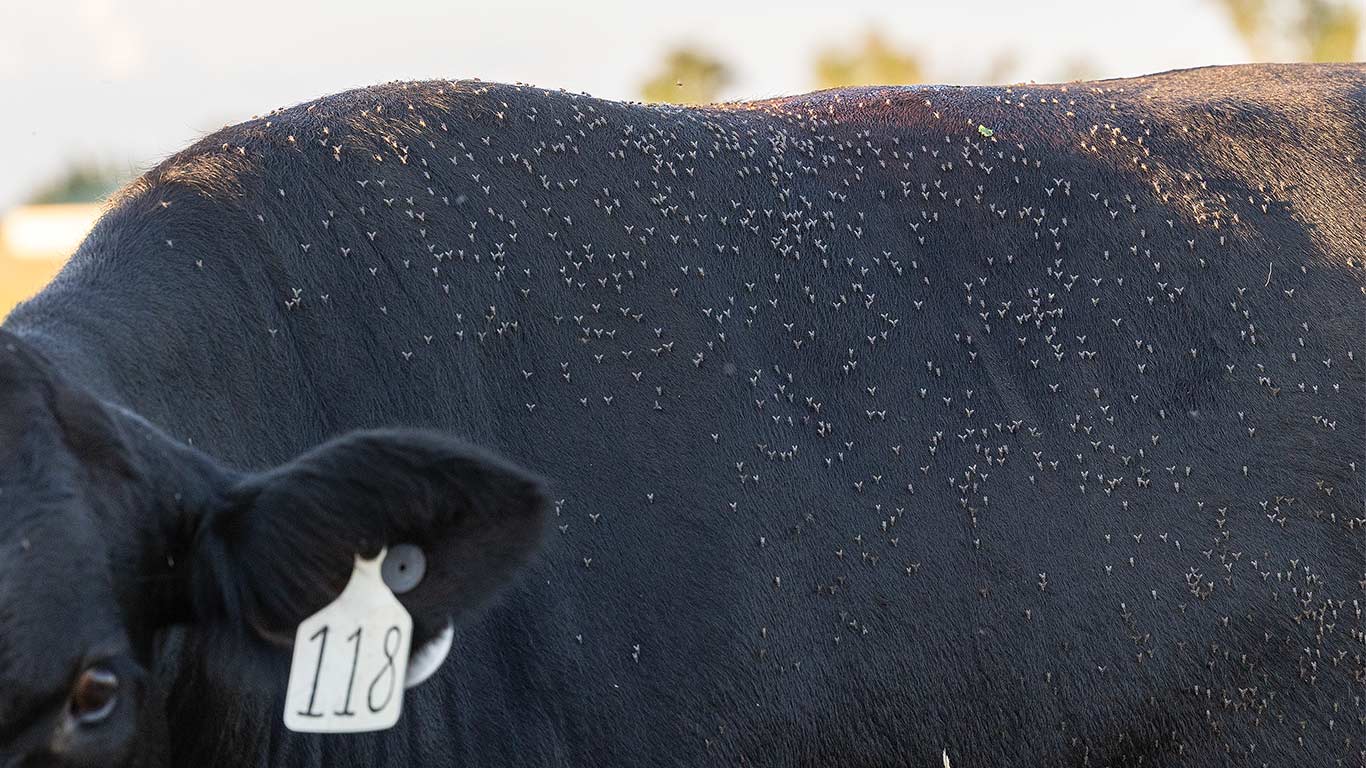
As few as 300 stable flies per animal can cause economic loss in cow-calf herds, according to research from several land-grant universities. Proper use of ear tags and rotating mode of action is imperative to keeping flies at bay.
Agriculture, Education January 01, 2026
Shoo, Flies!
Effective fly control is a quick way to add pounds to beef.
Story and Photos by Bill Spiegel
As she strides toward a rancher on a four-wheeler in a Kansas pasture, Number 118 stops every few steps to twitch or toss her head, trying to rid her body of the mess of flies swarming her face, backs, and sides.
The USDA estimates flies cost U.S. beef and dairy producers $5 billion per year in lost production, illness, and treatment.
"Cattle need blood, and anytime blood is removed it must be replaced," says Cassandra Olds, assistant professor of entomology at Kansas State University. "An animal spending energy replacing blood cells is not spending energy making muscle."
Know the enemy. Three main fly species—stable, horn, and face—annoy beef cattle in the High Plains, Olds says. These pests breed differently, have a different impact on cattle and require treatment protocols. It's important to know the difference between them.
Stable flies are the first pest of the spring. They reproduce anywhere there is decaying plant matter, so hay bales, mowed grass, and lawnmower clippings are a great host, she adds. A typical round bale can produce 58,000 stable flies per week.
Stable fly bites cause pain and distress to cattle, causing cortisol levels to increase and reduce the time cattle feed. Ten flies per front leg can reduce weaning weights by 38 pounds. In stockers, reducing the number of flies from four to one can increase average daily gain by 0.6 pounds, she adds.
Stable flies don't breed over winter, but they do become dormant. Flies will live where hay has been stomped into the ground, which should prompt producers to think about strategies to remove bale waste, such as spreading out feeding sites and gathering bale waste to burn or compost.
Horn flies have a "head down" orientation on the backs of cattle, and dedicate their lives to that one animal. Face flies, meanwhile, feed on mucus and secretions from nasal passages and eyes and travel from pasture to pasture in search of host animals, where they will transmit pinkeye from one herd to another. "Once pinkeye is in your herd, animals will transmit it to each other," Olds says.

Above. Cassandra Olds, research entomologist at Kansas State University, says the most important component in fly control is to know which flies are bothering the herd in the first place, then adopting strategies for each species.
Win the battle. The first step is knowing which flies ranchers are battling, she says. "Stable flies and horn flies have two different breeding sites. You must know what flies you have in order to target that breeding site."
Step two is to target their breeding sites. Stable flies thrive in decomposed plant matter, horn flies and face flies live in manure. Removing host material can thwart their ability to reproduce, Olds says. "If a fly doesn't have anywhere to lay 100,000 eggs, that's 100,000 fewer babies in two weeks. That's the explosive nature we have to curb."
Flies are not complex creatures. Their only job is to mate and reproduce, a job in which they excel, she says. "We will never beat them, so let's make life difficult for them," she explains.
Modes of action. A three-year rotation strategy that includes pyrethroid, organophosphate and macrocyclic lactone maximizes the effectiveness and efficacy of each product. Beef producers also need to know the proper protocol of ear tag use.
"Put ear tags directly into the ear, not onto an existing ear tag. And, tag both ears," she advises. "If you only use one ear tag, you're only covering half the body."
And, know that each tag provides only about 100 days of coverage. She recommends waiting until June or July to tag the herd, ensuring effectiveness during the heart of fly season.
"After 100 days, remove the tag. If you put another tag in, flies are exposed to insecticide for a longer period of time and keep developing resistance," she says. In reality, changing just a few key practices can help make cattle more efficient.
"Perhaps it's inconvenient to tag cattle in June rather than May, but more weight gain means more profit," she says. "At the end of the day, dollars drive decisions." ‡
Read More

AGRICULTURE, SUSTAINABILITY
Behind the Rusted Gate
Passion for local farms spurs demonstration effort.
AGRICULTURE, LIVESTOCK/POULTRY
Broiler Breeder
Supplying broiler chicks gives Ontario producer a great opportunity.