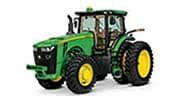
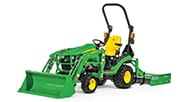
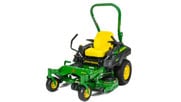
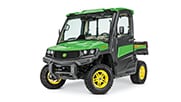
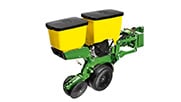
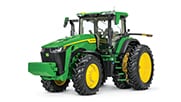
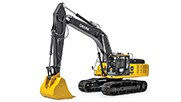
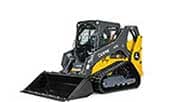




Our Interim Tier 4/Stage III B approach uses cooled exhaust gas recirculation (EGR) for NOx reduction and an integrated exhaust filter for particulate matter (PM) reduction. It is simple to operate and maintain while delivering the power, fluid efficiency, reliability, and low cost of ownership you've come to expect from John Deere.
The John Deere Advantage
Simple
The single-fluid approach of the John Deere cooled EGR engine platform is simple, operator friendly, and easy to maintain.
Fuel efficient
We offer a single-fluid solution for excellent total fluid economy. Our cooled EGR engines operate efficiently with ultra low-sulfur diesel as well as biodiesel blends, providing optimal performance and fuel-choice flexibility.
Field proven
We were the first to widely commercialize off-highway Tier 3/Stage III A cooled EGR diesel engines. Since 2005, we have used cooled EGR technology with a proven record of reliability in agriculture, construction, and forestry applications.
Integrated
We design, manufacture, and service the complete equipment package: engine, drivetrain, exhaust filter, ECU, cooling, and other vehicle systems. This integrated process maximizes performance, operator convenience, fuel economy, and overall value to you.
Fully supported
Our dealers are highly trained to help you maintain your Interim Tier 4/Stage III B engines.
Interim Tier 4/Stage III B Engine Brochure
Exhaust Filter Cleaning
Soot cleaning
We use an exhaust filter made up of a diesel oxidation catalyst (DOC) and a diesel particulate filter (DPF) to reduce particulate matter (PM). John Deere engines and exhaust filter components are designed for uninterrupted operation using passive regeneration, a natural cleaning process where engine exhaust temperatures are sufficient to oxidize the PM trapped in the exhaust filter. The process is continuous during normal engine operating conditions — greater than 30 percent load factor — and is the most fuel-efficient way to clean.
If conditions (temperature, load, or speed) for passive regeneration cannot be achieved, then PM must be removed using active regeneration, also an automatic cleaning process. This requires injecting a small quantity of fuel into the exhaust stream for a short duration and elevating exhaust temperatures to clean the filter. It's important to remember that, in most applications, active regeneration cleaning occurs only when passive regeneration isn't possible based on temperature, load and speed. It serves as a backup system. In either case, regeneration does not impact machine operation.
Ash cleaning
Over time, ash accumulates in the DPF and must be removed. The ash removal interval on John Deere machines is condition based, not hour based. The time when this service should actually take place will be flagged by your machine with a dash indicator or as required by diagnostic codes. Our test results and actual in-field performance shows that ash service intervals could extend significantly beyond the minimum levels required by the U.S. EPA of 4,500 hours for engines at or above 175 hp (130 kW) and 3,000 hours for engines below 175 hp (130 kW). In fact, ash removal may not be required for as long as 15,000 hours for engines at or above 175 hp (130 kW) and 8,000 hours for engines below 175 hp (130 kW). Actual intervals will be a result of your regular maintenance practices, such as the lube oil used, and specific machine application. When ash removal is required, your DPF can be exchanged for a clean one through your John Deere dealer.
Fluids and Other Maintenance
Ultra-Low Sulfur Diesel (ULSD)
Only use ULSD fuel in your IT4 engine, and fill your machine at the end of the day to reduce the chances of condensation from overnight cooling. Inspect and maintain fuel filters on the machine and storage tanks. Follow good bulk fuel storage practices. Ask your local dealer for details on fuel specifications and recommendations.
Biodiesel
If you opt to run biodiesel, we suggest using a 5-percent blend (B5), but a biodiesel concentration of up to a 20-percent blend (B20) can be used. All biodiesel must meet ASTM D6751 (U.S.), EN14214 (EU), or equivalent specifications.
Fuel additives
Use only our approved fuel additives, found in your operator's manual. Regardless of what fuel or additive you use, frequent fuel sampling and analysis is a good fleet-management practice that we highly recommend.
Low-ash oil
Use only low-ash CJ-4 oil such as John Deere Plus-50™ II. This oil reduces the ash in your exhaust filter and prolongs intervals between filter ash removal service. We also recommend frequent oil sampling and analysis.
Coolant
Our IT4 machines will notify your operator if the coolant level is low. Use only Cool-Gard™ II antifreeze developed specifically for your IT4 engine.
Engine crankcase filter maintenance
Our earlier-Tier vent tubes have been replaced by open crankcase ventilation systems. No service is required for engines rated above 130 kW (175 hp). For engines rated below 130 kW (175 hp), the open crankcase ventilation system must be serviced every 2,000 hours.
Interim Tier 4 Videos