



Construction

 Construction
Home
 Products &
Equipment
 Services &
Support
 Parts Finance
Solutions
 Where
to Buy
 Info
Center
 
About Our Company
Calendar of Events
Construction Equipment Review
Worksite Journal
Contact Us
Press Releases
Biodiesel
Equipment Image Gallery
Screen Savers
Technician Opportunities
Dealership Opportunities
Stories from the Job Site

Mass Excavation 201...making money in the mud.

John Holmes, John Deere.

John Holmes, John Deere Product Consultant

You know how to move tons of dirt and how to measure productivity. But did you know that a fresh perspective on equipment selection might hold the key to moving earth more efficiently and profitably?

It's been said that on a clear day you can see forever.
Well, on a dry day you can move dirt forever, often with maximum productivity. But what happens when it rains? Can equipment choices really dampen the effects of an uncooperative weather man?

A John Deere training session called
"Mass X — Extreme Earthmoving" tackled the mud dilemma by comparing various equipment combinations to find out which is best. The results might surprise you.

First, a couple of definitions; we'll use two different, general terms to describe the types of machinery covered "in class." "Production machinery" encompasses scrapers, dozers, tractors — anything that moves dirt from cut to fill — while "support machinery" refers to anything that isn't moving dirt, such as motor graders and water trucks that maintain a haul road, or a roller that compacts the fill. Now, eyes on your own paper, and let's get to work.

Today's lesson: The bad stuff
"There's mud and there's bad mud,” says John Holmes, product sales consultant for John Deere and professor for the mass-excavation class. "Mud is wet dirt and generally has a firm bottom under it. Bad mud is really wet; you have no real bottom for traction, and it’s easier to get stuck. This is the material that separates contractors (those who can handle the challenge and those who are at the mercy of nature), and you may have to figure extra costs for additional support machines.

"These additional machines could be a crawler with a cable to pull out stuck machines, a push dozer, or an excavator to load vehicles. You might even have to use a disc tractor on the fill. The site may also change — you may need a waste or drying area. That means even more expenses to think about. The drying area is necessary because you can't put the mud into the fill — you won't get compaction. Mud has to be dried out before it's moved into the fill. All these things challenge the contractor and test his equipment choices."

Holmes and other Deere demonstrators put various machines to work in the muck.

Self-propelled scraper with crawler push

The conventional scraper needs a push in the mud because it can have problems getting "squared up" in front of the push dozer. It shimmies in the mud, a phenomenon known as duck walking. "Also, the scraper's operator has to stop and wait for the dozer, because if he spins his tires, he's going down," Holmes says. "And when he is square and the dozer pushes, the scraper's tires are plowing material out.  He also has to pump his bowl to force material into the bowl, and there's no way to get a full bowl load." Holmes comments on how the scraper struggles to keep going. "If it really bogs down, we might have to bring in some dry dirt with a dozer to get things moving. Obviously these conditions might require additional support machines and added costs. You might have to bring in an excavator to dig out in front of the scraper and take material out of the bowl," Holmes notes.

In all, production from the self-propelled scraper/crawler push was very poor, moving little dirt and taking a significant amount of time, far longer than what the same machine combination could achieve in dry dirt.

Crawler pulling a scraper

The next combination to take the field was a John Deere 850J Crawler Dozer with a 15.5-cubic-yard Ashland 155 XL2 pull-behind scraper. "Here's where a crawler will pay off," Holmes says.

"A self-propelled scraper is carrying the machine's weight, plus the weight of the dirt, on four tires. With the Deere 850J, we're carrying the weight of the power unit on the tracks, and only the weight of the material is carried in the scraper bowl, so we're essentially reducing the load per tire," Holmes says.

The weight issue and the flotation of the tracks make this system work much better in muddy material, but Holmes observes how the scraper still can't fill the bowl fully and how the machines could still get stuck. "You have to get what you can and get out. If you stay in the cut too long, you'll add time and cost."

A larger dozer with a pull-behind

The next combination up was a Deere 1050C Crawler with 28-inch track pads pulling a 26-yard Bron scraper. "The idea here is to get as much flotation as possible so the pulling unit can stay on top of the mud. Compared to a self-propelled scraper, there's a big difference where this system applies ground pressure."

When the demonstrators filled the self-propelled scraper, there were approximately 114,000 pounds of pressure on the tires when loaded, with 31,000 pounds on each front tire and 26,000 pounds on each rear tires. The 1050C/Bron scraper combination weighed 54,000 pounds fully loaded, but there were only 12,000 pounds on each front tire and 15,000 pounds on each rear tire. "This is a big advantage because you dramatically reduce the chances of getting stuck. That's because you don't transfer any weight from the scraper bowl on to the crawler," Holmes says.

The Auto-Load Scraper Special

The popularity of dirt-hauling systems with modified agricultural tractors and pull-behind scrapers is on the rise. One reason for that is John Deere's 9520 Auto-Load Scraper Special. The system features a tractor with a different center section than its agricultural counterpart and a more robust rear support system.

How does this combination work in the mud? "The 9520 transfers up to 22,000 pounds through its drawbar, which gives it more leverage. On a crawler, we don’t need to transfer weight through the drawbar because we have enough traction and want more flotation," explains Holmes.

In "bad" mud, crawlers are the way to go because of the better flotation, but in "good" mud, you can try a tractor with dual tires for good flotation.

Tractor with pull-behinds

Another way to use the 9520 in the mud is with two pull behind ejector-style scrapers. This configuration helps to get a more even weight split between the tractors and scrapers.  Many contractors will load the front scraper with dry material and then use an excavator to top-load the second with wet material, so when they go to the fill, they're mixing wet and dry dirt together.

If an excavator is brought in to increase productivity, you might want to use a dozer like the 850J to push mud to the excavator. That way the excavator operator won't waste time reaching for material. Whatever the combination or the support machinery required, the object is always to load the scraper as quickly as possible.

The two ejector scrapers used in the demonstration were a John Deere 1814E and an 1810E. Both feature an 18-cubic-yard capacity, but have different cuts: 10 foot and 14 foot, respectively.

"Wet material is a very good application for ejector scrapers," Holmes says. "Many contractors prefer them because of how fast they can be loaded and unloaded from a lowboy. The 1810 is longer, narrower, and easier to top-load than the 1814."

"In some situations, depending on how wet the soil is, you can keep the tractor up on the good material and then back the scrapers into the mud," Holmes explains. "That way the tractor gets good traction and can go to the fill quickly."

Unfortunately, a lot of guys will pull two scrapers until they get stuck. While it's true you can use a quick-attach hitch and drop one in five minutes, you’re still curbing productivity.  Also, be sure to dump the second scraper first and keep your weight up-front."

Adding an excavator and an ADT to the mix

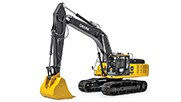
"In 'bad' mud, top-loading with an excavator and an ADT is usually the best choice," Holmes explains. First, the demonstrators showed a John Deere 450D LC Excavator and a self-propelled scraper. "When you top-load an excavator, always load from the rear, never over the operator's station. Set the bowl on the ground to avoid damaging the lift circuit. You can experiment to find the ideal load that won’t require a pusher while pulling out in soft ground."

Bringing in an ADT to haul dirt to the fill can not only increase speed and efficiency, it can also spread out the load; there are six tires instead of four, combined with six-wheel drive instead of two-wheel drive. Deere ADTs have a transport speed of 32 mph, which increases production. A truck equipped with a tailgate prevents unintentional dumping on the way to the fill.

The bottom line with mud

"Very simply, there’s a reduction in production with mud," Holmes says. "There are extra operating costs due to using more machinery - and drying isn’t necessarily the answer. Drying would mean you’re handling the dirt twice."

All the extra costs cut into profits. Just how thin is the line? "A contractor says his average margin is 5 to 15 percent; well, 5 percent of a typical 8-hour day is 24 minutes," notes Holmes. "Think of it this way; in the first 7.5 hours of the day, he’s just covering his overhead — he doesn’t start making a profit until the last 24 minutes, and that's why he's checking cycle times so closely. Saving a few seconds on every cycle puts more dollars in his pocket."

According to Holmes, operating in mud adds approximately 35-to-40-percent more cost to every machine combination. Even the addition of support machinery for loading, traction, and haul-road maintenance do not make up this basic difference.

"To interpret our numbers for 'real-world' totals, we need to measure more than just cycle times; we also looked at machine purchase price, material moved, and fuel consumption," says Holmes. "Most jobs have more than one excavation system tackling the application, for one thing. Fleets would be a more likely solution, especially on large projects. So for our next exercise we figure three sets of identical earthmovers would be on the job, i.e., one 1050C Dozer pushing three scrapers, three 9520s, and so on. The chart LOCATION also shows the support machinery we figured into the equation.

"In 'good' dirt, the Deere 9520 Tractor/Scraper system moved 1,728 cubic yards per hour, but in the mud we get only 168 cubic yards an hour – and that's after dropping the second scraper. So you can see the impact mud has on cost per yard."

Holmes went on to note that adding a 450D LC Excavator and articulated dump trucks (ADTs) costs 84 cents per yard. "The fleet value was the second highest of all the combinations we tried, but there was a significant increase in the number of cycles per hour and the amount of dirt we were able to handle. In fact, no other combination could come in below $2 per cubic yard.

"Simply changing material — muddy versus dry — turns your best fleet choices and their corresponding costs per hour upside down," Holmes concludes. "What was most costly and least efficient in dry dirt is the best, most cost effective way to handle mud."


  PrintPrint   
Copyright © 1996-2008 Deere & Company.
All Rights Reserved.
About Our Site | Privacy | Legal