





Construction

 Construction
Home
 Products &
Equipment
 Services &
Support
 Parts Finance
Solutions
 Where
to Buy
 Special
Offers
 Info
Center
 

About Our Company
Calendar of Events
Construction Equipment Review
Worksite Journal
FAQ / Contact Us
Press Releases
Biodiesel
Equipment Image Gallery
Screen Savers
Technician Opportunities
Dealership Opportunities
Philanthropy
Stories from the Job Site

Fuel for Thought

John Deere Refueling

Because John Deere engines use High-Pressure Common Rail (HPCR) fuel systems for the precise fuel control needed to help meet emissions standards, your fuel's quality and condition are vital to engine performance. The message? Don’t put just anything in your tank.

Here are some fuel-related tips in the areas of quality, content, additives, storage, and filtration to help keep your fleet running smoothly.

Quality

  • Diesel fuels specified to EN 590 or ASTM D975 are required.
  • Request a Certificate of Analysis from your fuel supplier.
  • The Cetane number should be a minimum of 45, while a number greater than 50 is preferred, especially for temperatures below –4°F or elevations above 5,000 feet.
  • The Cold Filter Plugging Point should be at least 9 degrees below the expected lowest temperature, or Cloud Point below the expected lowest temperature.
  • Fuel lubricity should pass a maximum scar diameter of 0.45 mm as measured by ASTM D6079 or ISO 12156-1.
  • Particulates should be less than or equal to 10 mg/L per the ASTM D2276 test.

Hydraulic bypass filters are equipped with a high-efficiency, micro-filter element that uses a radial flow path. The element is made of a unique 0.5-micron cellulose media that captures far more particles than the conventional 10- to 15-micron full-flow filters. It retains the destructive smaller particles of contamination and absorbs water. Note that elimination of water helps prevent chemical deterioration and the formation of harmful acids and sludge.

The use of diesel fuel with a sulfur content less than 0.10 percent (1,000 ppm) is strongly recommended. Low-sulfur diesel (0.05 percent or 500 ppm) and ultra-low sulfur diesel (0.0015 percent or 15 ppm) are both acceptable.

Use of diesel fuel with a sulfur content of 0.10 to 0.50 percent may result in reduced engine oil- and filter-change intervals. Contact your John Deere dealer before using diesel with a sulfur content greater than 0.50 percent.

John Deere Refueling

Biodiesel
While 5-percent (B5) blends are preferred, biodiesel concentrations up to 20-percent blends (B20) in petroleum diesel fuel can be used in all John Deere engines. Biodiesel blends above B20 can be used only if the biodiesel (100-percent biodiesel or B100) meets ASTM D6751 (US), EN 14214 (EU), or equivalent specification. If you use B20, expect a 2-percent reduction in power and a 3-percent reduction in fuel economy. If you use B100, expect a 12-percent reduction in power and an 18-percent reduction in fuel economy. John Deere-approved fuel conditioners containing detergent/dispersive additives are recommended when using lower biodiesel blends, but are required when using blends of B20 and greater.

Additives
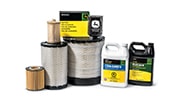
If a conditioner is required, we recommend John Deere Premium Fuel Conditioner. Your dealer offers a full line of fuel conditioners for use with all types of fuel, including biodiesel, in all types of climates. To prevent plugged fuel system components from any level biodiesel or ultra-low sulfur diesel fuel, we recommend John Deere FUELSAVER. Unapproved additives may damage engines. Additives with the following characteristics will likely lead to fuel system damage, performance/power loss, general system fouling, and/or unwarrantable failures:

  • Ash-forming materials.
  • Calcium-based additives.
  • Automatic transmission fluid.
  • Home heating oil. Never use engine oil or any other lubricating oil as a fuel additive.

Fuel storage and handling
Diesel and biodiesel fuels degrade over time, so extended storage should be minimized. Straight diesel may begin to degrade after a year of storage, while biodiesel blends up to B20 must be used within 90 days of manufacture. Blends from B21 to B100 must be used within 45 days of the date of biodiesel manufacture. Some recommendations for source and storage tanks:

  • Fully functioning caps and vents.
  • Keep tanks as full as practical to help prevent condensation/freezing.
  • Allow 24 hours for a new batch of fuel to settle before pumping it into another tank.
  • Be sure there’s a well-serviced filter between the pump pick-up and the nozzle to capture any debris before filling a vehicle tank.
  • If equipped, drain sediment and water using a drain valve on the bottom of the tank.
  • Completely drain the tank at least every year, and rinse it with diesel fuel. Minimize exposure to direct sunlight and heat to help maintain fuel stability.
  • Treat with an antimicrobial additive -- a shock treatment is recommended when microbial growth is suspected, and a maintenance treatment is recommended with each fill-up.

Machine filtration
Use filters with dual-stage fuel filtration to capture harmful debris and water before it reaches downstream components. Filters should be properly maintained and replaced at least every 500 hours. Check the filter's water bowl daily and drain any water. If the filter's water-in-fuel sensor triggers an alarm, the engine should be stopped immediately and the water should be drained. To protect hydraulic systems from moisture contamination, installation of desiccant breather valves is recommended. Used with a robust fluid analysis program, this can also extend fluid drain intervals and reduce operating costs.

Back to Stories from the Job Site


  PrintPrint   
Copyright © 1996-2009 Deere & Company.
All Rights Reserved.
About Our Site | Privacy | Legal